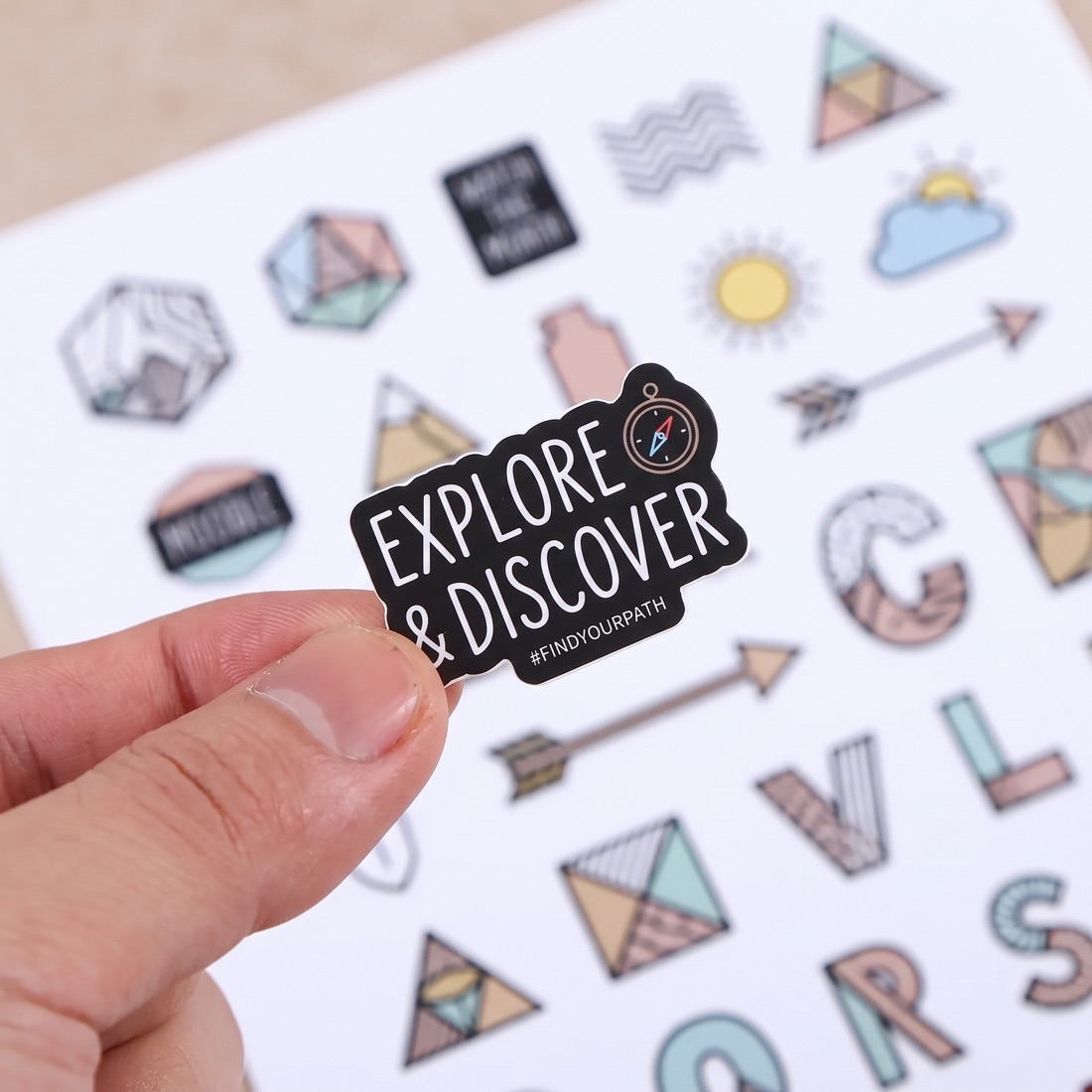
Découpe à l'emporte-pièce?
Comment l'autocollant prend sa forme. Trois découpes, un support, et la seule décision qui sépare une feuille autocollante d'un désordre susceptible de se coincer sur une ligne à grande vitesse.
Ce que c'est
La découpe à l'emporte-pièce est l'étape qui donne à une étiquette son contour. Une lame en forme — l'emporte-pièce — presse à travers le matériau afin que l'étiquette finie puisse être décollée et appliquée. Il existe trois profondeurs de découpe, et choisir la mauvaise est une erreur courante et évitable.
Découpe à mi-chair découpe uniquement le frontal et l'adhésif, laissant le support intact. Cela crée un support protecteur autour du design, rend l'étiquette facile à décoller sans toucher l'œuvre, et permet à plusieurs étiquettes de se trouver sur une seule feuille. Découpe à l'emporte-pièce (découpe complète) découpe à travers le matériau et le support, suivant exactement la forme du design — le résultat est une étiquette finie, autonome, sans déchets environnants. Découpe traversante utilise des découpes intérieures pour créer un espace négatif à l'intérieur du design afin que la surface derrière soit visible.
Comment cela est-outillé
Deux méthodes d'outillage existent, et les économies divergent fortement selon le volume. Matrices en acier comportent un coût d'outillage unique qui doit être couvert indépendamment de la taille de la commande ; il est chiffré séparément et amorti sur la durée de vie de la matrice. Les formes standard couramment disponibles — ronds, ovales, rectangles, carrés — n'ont pas de coût d'outillage car les matrices existent déjà.
Pour des volumes plus faibles ou des formes prototypes, la découpe à l'emporte-pièce au laser rotatif évite complètement une matrice physique, au prix de vitesses de production légèrement plus lentes et d'une prime modeste par unité. Un contour véritablement personnalisé est plus économique à des volumes plus élevés ; une taille de matrice standard minimise l'investissement en outillage. Lors de la commande d'une forme personnalisée, confirmez le coût d'outillage à l'avance, qui possède la matrice, et si elle est stockée pour les nouvelles commandes.
À quoi cela sert
La découpe à l'emporte-pièce des autocollants individuels convient aux distributions promotionnelles et à tout produit expédié sous une forme autonome. Découpe à mi-chair est le choix pour les packs d'autocollants, les feuilles de planification et les designs avec des éléments délicats qui se déchireraient si on les décollait directement. Découpe traversante sert à des applications décoratives où l'espace négatif fait partie du design.
Pour les lignes d'étiquetage automatiques, la profondeur de découpe interagit avec le support antiadhésif : une matrice peu profonde qui laisse les fibres du support intactes est préférable à une matrice profonde qui les traverse et affaiblit le film.
Compromis
— ce qu'il faut savoir
La profondeur de découpe est une décision de résistance du film. Sur les applicateurs à grande vitesse, une matrice qui pénètre trop profondément dans le support lui enlève sa résistance à la traction au niveau de la ligne de découpe, et le film se casse sous la tension de distribution. La solution validée en production est un support plus lourd — en augmentant le poids du verre — ou un support enduit pour les lignes les plus rapides. Les deux coûtent plus cher ; confirmez le compromis par rapport à la longueur de votre tirage.
La chaleur modifie la découpe. Par temps chaud, l'adhésif s'assouplit, et le retrait de la matrice de déchets (le treillis environnant retiré après la découpe) devient difficile — la matrice se déchire ou laisse des résidus sur le support antiadhésif. Planifier la découpe pendant des heures plus fraîches, climatiser la zone de découpe et ralentir la vitesse de production aident toutes à atténuer ce problème. Attendez-vous à des délais de découpe à l'emporte-pièce légèrement plus longs lors des commandes en été.
Références croisées
S'accorde bien
avec ces entrées.
Tirage
Découvrez le matériau en personne — et non sur papier.
Les échantillons sont expédiés par avion en 3 à 5 jours, gratuitement pour les acheteurs qualifiés. Touchez le matériau avant de vous engager.