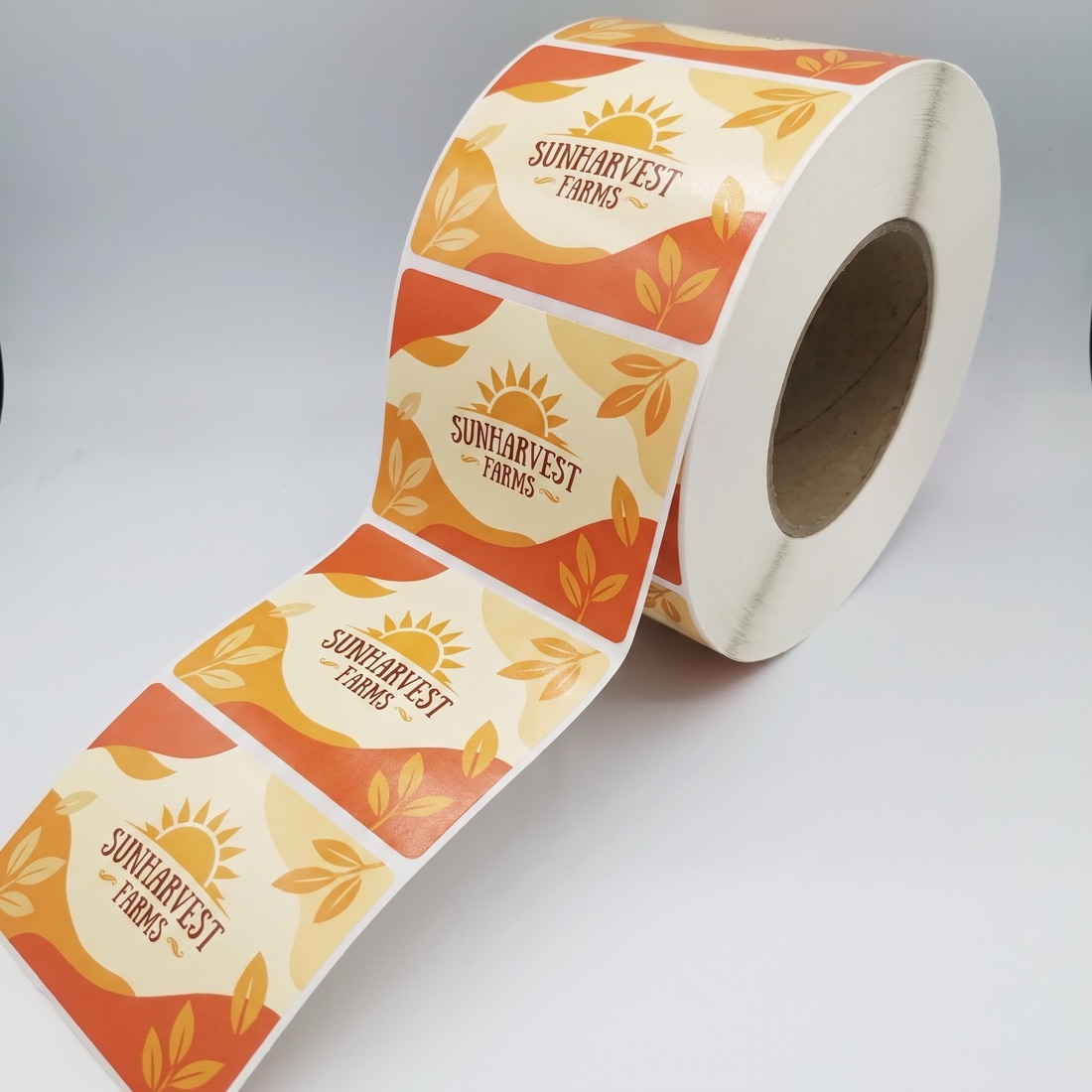
Roll vs Sheet?
Not a cosmetic choice. One format runs on any office printer with no minimum; the other unlocks lamination, low unit cost, and every automatic applicator on the planet.
What it is
Labels are supplied in one of two physical formats. Sheet labels ship as flat sheets — typically 8.5 × 11 inches — holding multiple label positions. They feed through standard inkjet and laser printers, need no special equipment, and carry no minimum order quantity. Roll labels are continuously wound around a cardboard core and require a thermal, inkjet, or laser roll printer, or a label applicator.
The two serve different production contexts, and picking the wrong one blocks capabilities you may need later.
Why the format decides your options
Automatic application is roll-only. Sheet labels are exclusively hand-applied; roll labels are required for any applicator machine, from a manual-trigger tabletop unit to a fully in-line system. If you plan to scale to machine application, you need roll format — a semi-automatic tabletop unit can lift throughput several-fold over hand labelling while removing most placement errors.
Lamination and low unit cost favour roll. Roll labels can be laminated (and thus weatherproofed) and cost less per unit at volume. Sheet labels win on flexibility: no minimum, in-house short runs, and variable data where every label is unique.

Core and roll specifications
A roll label is defined by two numbers: core diameter (the inner tube the label winds around) and outer diameter (the maximum roll the machine will physically accept). Standard cores are 1 inch (25 mm), 1.5 inches (38 mm), and 3 inches (76 mm). Most desktop label printers take a 1-inch core; most industrial printers and high-volume applicators require a 3-inch core — verify your equipment before ordering.
Some contexts have their own core rules: certain filling lines need 1-inch cores, and electronics manufacturing often calls for rigid plastic cores that hold their shape in clean environments. State the core you need at the quote stage.
Trade-offs
— what to know
Sheet: no equipment, no minimum, ideal for small businesses, short runs, and in-house variable-data work — but it cannot be laminated for weatherproofing and cannot run on an applicator.
Roll: lower unit cost at volume, laminatable, and the only applicator-compatible format — but it needs dedicated roll-printing equipment and usually a higher minimum when custom-printed. Match the format to how the labels will actually be printed and applied, not to which looks cheaper on a single line item.
Cross-References
Pairs well
with these entries.
Press Run
See the material in person — not in print.
Sample packs ship 3–5 day air, free for qualified buyers. Touch the material before you commit.