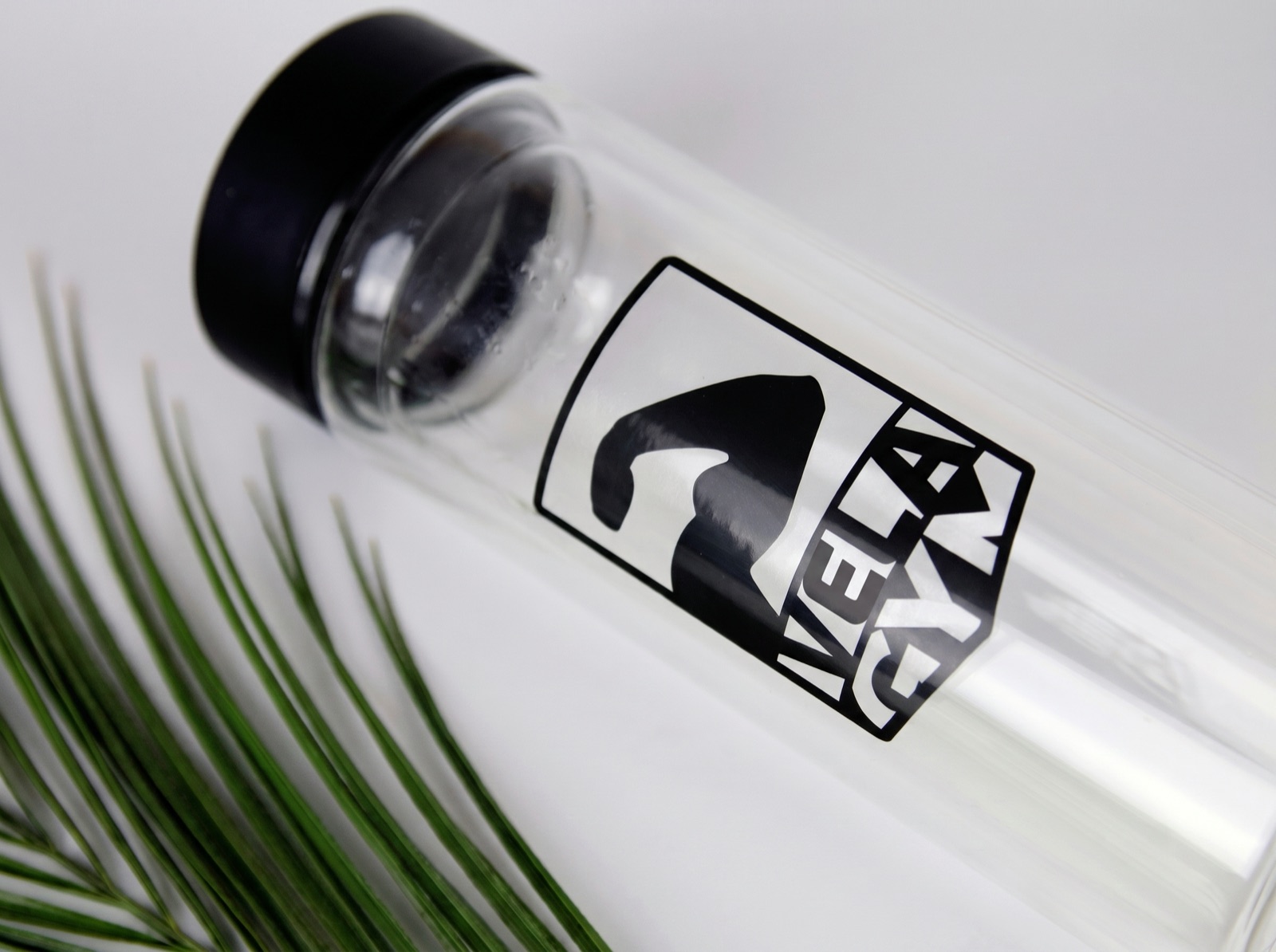
BOPP?
The no-label-look film. Clear, waterproof, food-contact safe, used on premium bottle wraps and cosmetic packaging across most of the DTC trade you respect.
What it is
BOPP — Biaxially-Oriented Polypropylene — is a clear, dimensionally stable plastic film made by stretching a polypropylene sheet in two perpendicular directions. The result is a face stock that is strong, glossy, completely waterproof, and largely chemical-resistant, while staying thin enough (25–80 µm) to wrap around a cylindrical bottle without lifting at the seam.
You see BOPP every day without naming it. It is the “no-label look” on a bottle of San Pellegrino, the lamination on a Lululemon mailer, the wrapper on a thousand fancy snack bars. In the label trade, BOPP is the workhorse premium film — cheaper than PET, more durable than vinyl, more refined than paper.
How it is made
Polypropylene pellets are melted, cast as a thick sheet, then reheated and stretched simultaneously along the machine direction and the cross-machine direction. This biaxial stretching aligns the polymer chains and dramatically improves tensile strength, transparency and barrier properties.
The film is then coated — usually with an acrylic or polyurethane top-coat that gives it printability with UV, eco-solvent or flexographic inks. Pressure-sensitive adhesive is laminated to the back, releasing onto a silicone-coated paper or PET liner.
What it is good for
Bottle wraps at the premium end — cosmetics, beverage, body care. The high transparency of clear BOPP creates the disappearing “no-label look” that DTC brands have built their visual identity around since roughly 2018.
Snack and food packaging where moisture, oils and refrigeration are routine. BOPP’s food-contact compliance (self-certified under FDA 21 CFR 175.105 for exterior labels) and barrier properties make it a default for food-adjacent packaging. Note BOPP handles refrigeration but not hot-fill above ~80 °C — reach for PET there.
Lamination over printed graphics — gloss or matte BOPP over an offset-printed sheet is the standard production technique for premium mailers, magazine inserts and limited-edition book covers.
Trade-offs
— what to know
BOPP is not heat-stretchable beyond a narrow window. If you need a label that conforms to an irregular curved surface — a hand soap bottle with a pronounced shoulder, for example — PET or vinyl is more forgiving.
BOPP has weaker adhesion to low-surface-energy plastics (HDPE, untreated polypropylene) unless paired with the right adhesive. Always specify the substrate when ordering.
BOPP is not the cheapest film face stock; paper-based labels are roughly 30–50% lower at comparable quantities. For a thrifty Etsy run, paper still wins. For a premium DTC bottle, BOPP is almost always the right answer.
Cross-References
Pairs well
with these entries.
Press Run
See the material in person — not in print.
Sample packs ship 3–5 day air, free for qualified buyers. Touch the material before you commit.