Comparison · Nº 02
Holographic Paper vs. Holographic Vinyl
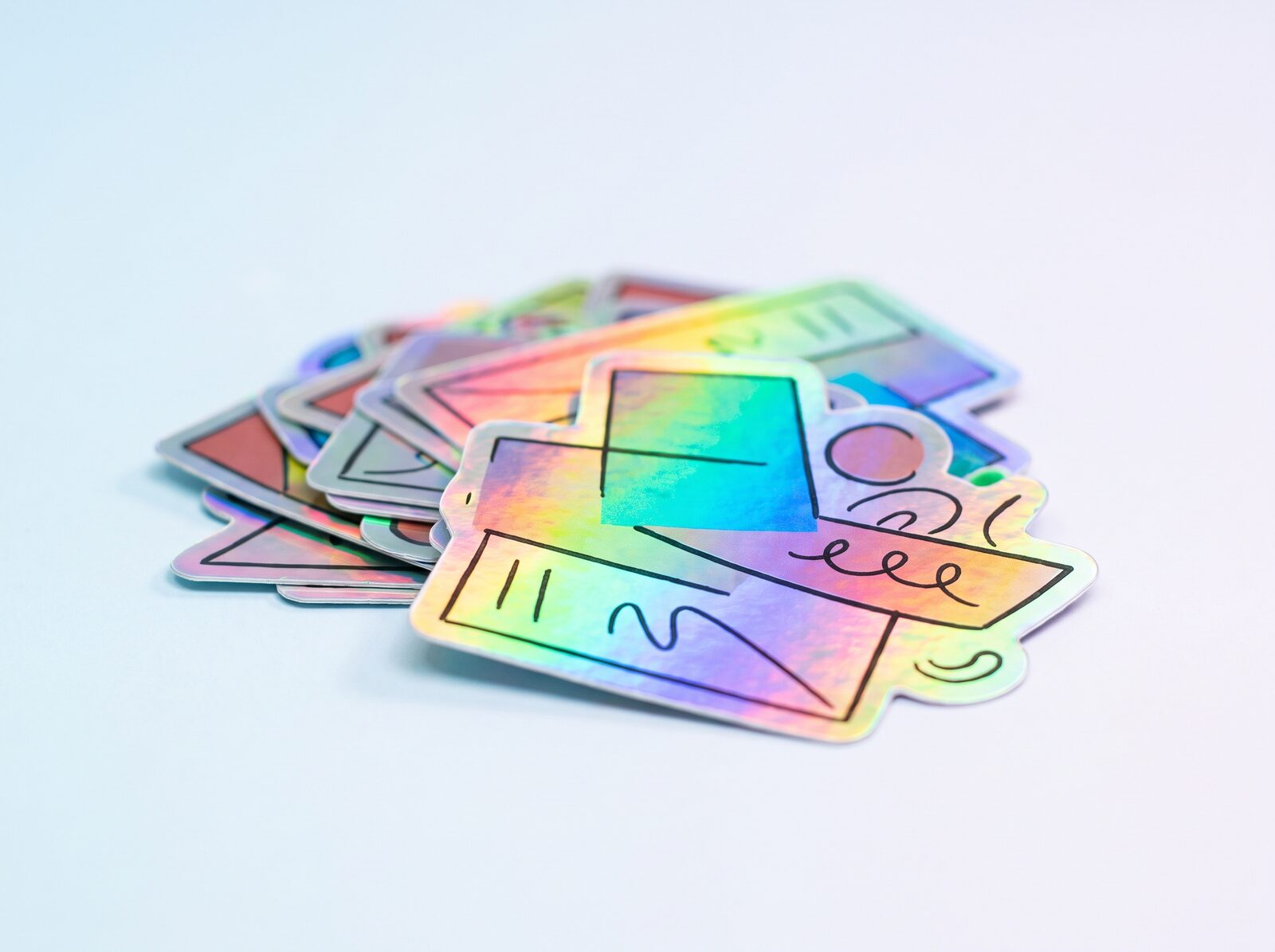
The two most-requested specialty finishes for sticker shops. They look superficially identical in marketing photos. In hand, they are entirely different materials with entirely different ideal use cases.
Side by side
The specifications, measured.
★ = clear advantage at this property
When to pick which
The decision, by use case.
- →You’re an Etsy seller running on a home Epson or Canon inkjet.
- →You want a softer, more journal-friendly feel — buyers describe it as “not plasticky.”
- →You’re die-cutting at home with a Cricut or Silhouette and want clean cuts without blade replacement.
- →Use is indoor decoration — laptop, journal, gift packaging.
- →Budget per sheet matters, and the project is short-life (under 12 months).
- →You’re a print shop or DTC brand with eco-solvent, UV or latex printers.
- →The application is outdoor or long-life — window decals, branded packaging meant to last.
- →You need the sharpest possible holographic effect — the plastic substrate holds the prismatic finish more crisply than coated paper.
- →The surface will face frequent water contact — beverage bottles, outdoor signage.
Common questions
Answered straight.
Which holographic label lasts outdoors?
Vinyl — 12–36 months outdoors versus 3–6 months for coated holographic paper. Use holographic vinyl for window decals, beverage bottles and outdoor signage; paper is for indoor decoration.
Can I print holographic paper on a home inkjet?
Yes — coated holographic paper prints on home inkjet and laser, and die-cuts cleanly on a Cricut or Silhouette. Holographic vinyl usually needs a pro eco-solvent, UV or latex printer.
Which has the sharper holographic effect?
Vinyl — the plastic substrate holds the prismatic finish more crisply. Paper is warmer and softer. For maximum shine pick vinyl; for a journal-friendly feel pick paper.
Editor’s verdict
For Etsy and small-batch decorative work, holographic paper wins on cost, printer compatibility, and tactile feel — it’s the right answer for most home-printer shops. For outdoor, beverage-bottle, or print-shop production runs, holographic vinyl is the upgrade path. The shopkeeper’s rule: paper for the journal page, vinyl for the water bottle. Buy both as samples — the difference in person decides this faster than any spec sheet.
Press Run
Sample both — and decide.
We ship a side-by-side sample of either material free, in 3–5 days. Decide with your printer, your bottle, your shipping process.
Materials facts verified by
Kevin— co-founder, materials & manufacturing, Guangzhou. Every claim traces to the factory-floor knowledge base.About Euphora →